
The Room Behind the Lantern Light
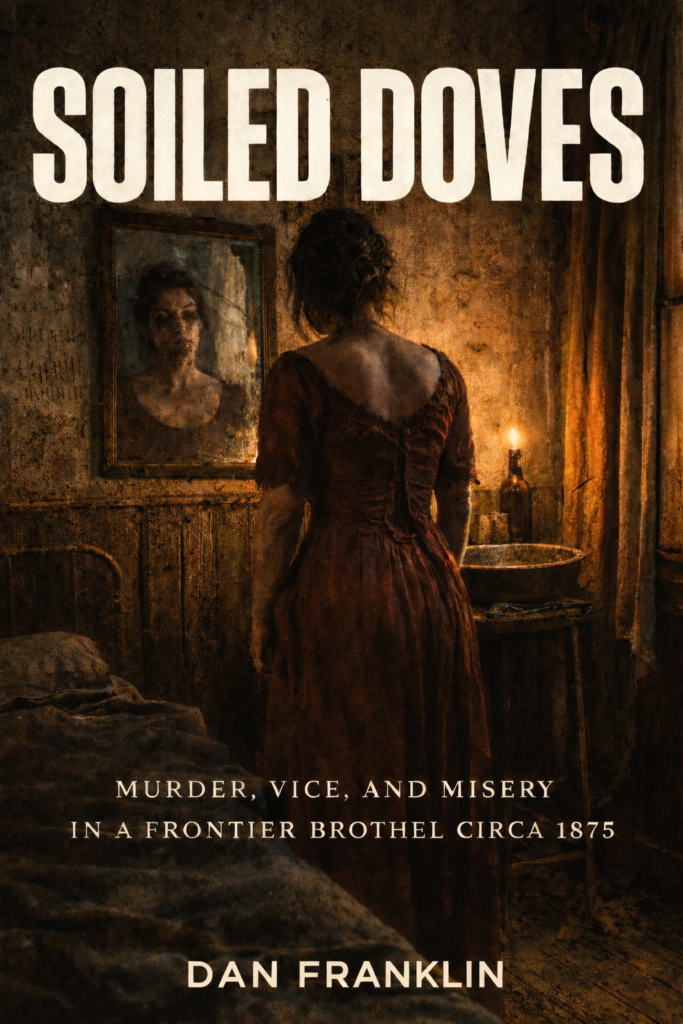
The lantern burned low in the corner of the room.
It threw a dull amber glow across the warped floorboards and the narrow bed pressed against the wall. Outside, the street was still loud — boots on the boardwalk, piano music drifting from the saloon next door, men shouting over whiskey and cards.
Inside the room, everything was quiet.
A woman sat on the edge of the bed with a ledger open on her lap.
The pages were filled with numbers written in tight, deliberate handwriting.
Room charge.
Dress charge.
Meal charge.
Doctor’s visit.
Whiskey for a client.
The columns added up in the same direction every week.
She owed more than she had when she arrived.
Downstairs, the madam laughed with a group of cattle drovers celebrating the end of a long drive north. Money moved across the bar. Glasses clinked. Someone kicked open the piano lid and shouted for another song.
The frontier liked to call women like the one upstairs “soiled doves.”
The phrase sounded almost poetic.
It was meant to.
Because the truth behind it was far less comfortable.
The Boomtown Equation
The American West did not produce brothels by accident.
They appeared wherever the frontier economy reached its most unstable form — boomtowns filled almost entirely with men who had money in their pockets and nowhere respectable to spend it.
Mining camps.
Railroad depots.
Cattle towns at the end of long drives.
Places like Dodge City, Deadwood, Virginia City, and Tombstone could have male-to-female ratios as extreme as ten or even twenty men for every woman.
Those numbers created a market almost overnight.
A town might begin with tents and muddy streets, but within weeks one building would appear near the center of the action: the saloon. Not long after, another would open nearby offering rooms, music, and female company.
The sex trade on the frontier was not a fringe operation.
It was infrastructure.
Municipal governments frequently licensed brothels, taxed them, and used the revenue to fund basic services. In some towns, prostitution generated more reliable income for the local treasury than property taxes.
The arrangement was simple.
Men earned money from cattle, gold, silver, timber, or railroads.
They spent a portion of that money in brothels.
And the town quietly depended on the cycle.
But the women who powered that economy rarely appeared in the official story.
The Recruitment Pipeline
The mythology of the frontier loves a particular image: the independent saloon girl who chose the profession for freedom and adventure.
The historical record tells a different story.
Many women arrived in the West through fraudulent employment advertisements placed in eastern and Midwestern newspapers. These ads promised respectable jobs as domestic workers, hotel staff, or laundresses in booming western towns.
When the women arrived, the job waiting for them was not what they had been promised.
The travel costs that had been “advanced” to them — train fare, meals, clothing — were entered into a ledger.
That ledger became debt.
And the debt became the mechanism that kept them in the trade.
Once inside the system, leaving was nearly impossible. Women owed money for their room, their food, their clothing, and even the alcohol purchased by their clients. The accounts were controlled entirely by the brothel operators. The math always worked against the worker.
The result was a form of economic captivity that could last for years.
Life Inside the System
Hollywood eventually gave the frontier brothel a glossy aesthetic: velvet curtains, piano music, flirtatious laughter.
The real conditions were harsher.
In many mining camps and cattle towns, women worked in crib districts — rows of tiny wooden rooms barely larger than the beds inside them.
A typical night might mean seeing fifteen to thirty clients during busy seasons when cattle drives ended or mines paid their workers.
Violence was common.
So was disease.
Medical records from the period show widespread outbreaks of syphilis and gonorrhea in frontier towns. Treatments often involved mercury-based compounds that were nearly as dangerous as the illness itself.
Alcohol and opiates were not merely recreational.
They were workplace tools.
Women were frequently encouraged — or required — to drink with customers because alcohol increased spending. Over time, dependency became another form of control.
When illness or addiction made a woman unable to work, the system had little use for her.
Her name might disappear from the ledger.
But the ledger itself never closed.
The Town’s Open Secret
Frontier communities lived in a strange balance with the sex trade.
Publicly, ministers condemned it.
Privately, town councils regulated it.
Sheriffs often ignored violence against prostitutes unless it spilled into the streets where respectable citizens could see it.
Everyone understood the arrangement.
The brothel district stayed a few blocks away from the main street.
The money flowed into local businesses.
The illusion of moral distance remained intact.
This quiet tolerance ended abruptly during the early twentieth century when reform movements pushed to close vice districts across the country.
The closures were celebrated as moral victories.
But for the women who depended on the brothels for survival, the results were often catastrophic.
Many were suddenly unemployed with no savings, poor health, and no social safety net.
The system that had exploited them simply discarded them.
The Vanishing
Walk through the historical museums of frontier towns today and you will find gunfighters, sheriffs, and cattle barons.
You will find stories about gold strikes and dramatic shootouts.
You will rarely find the women whose labor helped sustain those towns.
Many of them died young.
Some disappeared into poverty when brothels closed.
Others changed their names and tried to rebuild their lives somewhere far from the towns that had consumed them.
In official records, they often survive only as brief entries in coroner’s ledgers.
Sometimes only a first name.
Sometimes not even that.
Just a cause of death written in a single word.
“Dissipation.”
The frontier produced legends easily.
But the lives that supported those legends were often erased.
The Forensic View
When we strip away the mythology, the frontier sex trade looks less like scandal and more like a system.
A system built on:
• demographic imbalance
• rapid economic booms
• limited employment options for women
• fraudulent recruitment networks
• debt-based labor control
• municipal complicity
It functioned with remarkable consistency across hundreds of towns.
And it left behind thousands of women whose stories were rarely recorded.
Recovering those stories is slow work.
Sometimes all that remains is a ledger entry.
Sometimes a coroner’s report.
Sometimes a single line in a newspaper that no one noticed at the time.
But each fragment adds another piece to the record.
Because history, like any investigation, begins with evidence.
And the evidence rarely matches the legend.
Closing Note
This article draws from the research behind Soiled Doves: The Grim Economics, Disease, and Coercion Behind the Frontier Brothel, which examines the hidden systems that shaped prostitution in frontier boomtowns and the women whose lives were consumed by that economy.